Recent Articles Related To Physics
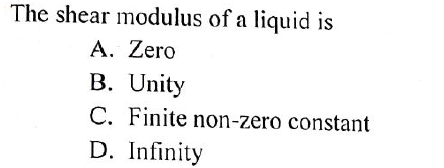
Shear Modulus of a liquid ? Jamia Millia Islamia University BSc Nursing 2024
As you know that the shear modulus, also known as the modulus of rigidity, is a measure of a material's resistance to shear deformation, and since liquids readily deform under shear stress (i.e. readily changes their shape on application of stress so it can be said that NO resisatance ), so their shear modulus is considered to be zero
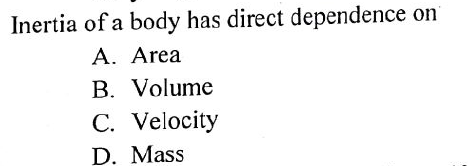
Dependence of inertia. Jamia Millia Islamia University BSc Nursing 2024
Mass
Inertia is related to heaviness or lightness.
Velociy is responsible for momentum while inertia can come into play when body is in rest also.
Angle for maximum resultant of two vectors? Jamia Millia Islamia University BSc Nursing 2024
Two vectors will have their vector sum maximum when they act parallel i.e angle between them is zero, option A here.
For mathematical explanation refer to the formula of parallelogram, it will give that resultant (R) will be maximum when the angle is zero.

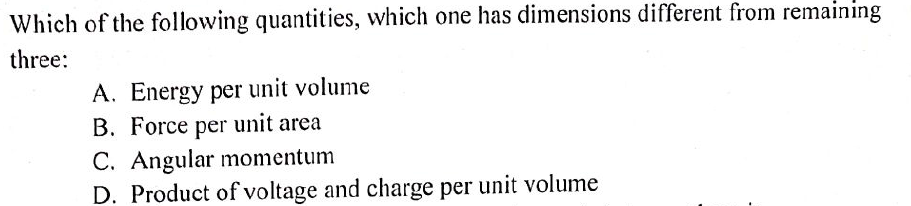
Choose correct option having dimension different from other. Jamia Millia Islamia University BSc Nursing 2024
As we know that from our text book:-
Work and energy has same dimensions so energy upon volume and work upon volume will have same dimensions while work is force*displacement (W= F*d) so work/volume will have dimension of Force/area as volume has dimension of area*length.
Similarly voltage*charge is nothing but work so volatge*charge/volume will have same dimension as work/volume that is same as that for A & B so A,B and D have same dimensions leading to C as correct answer (different from A, B & D)
भौतिकी के सैद्धांतिक /आंकिक प्रश्नों (theoratical/Numerical Questions) के लिए मददगार कुछ महत्वपूर्ण बिंदु - भाग -2
- जैसा कि हम जानते हैं कि पवन की दिशा उच्च दाब से निम्न दाब की ओर होती है, अर्थात उच्च दाब की ओर से हवा निम्न दाब की ओर धकेलती है। साथ ही हम यह भी जानते हैं कि बरनोली प्रमेय के अनुसार जिस तरफ पवन की गति तेज होगी उधर हवा की दाब उर्जा कम हो जाएगी परिणाम ये होता है की आंधी में किसी घर पर पड़ी हुयी टीन की चादर के ऊपर तेज पवन के चलते हवा का दाब कम रहता है जबकि चादर के नीचे स्थिर हवा के चलते ज्यादा वायु दाब जोकि बाहर की तरफ दबाव डालता है और चादर उड़ जाती है, कंक्रीट की छत नहीं उडती क्योंकि मजबूती से जुड़ी होती है और भारी होने के चलते हवा का दबाव इसके भार को संतुलित नहीं कर पाता |
- डिग्री ऑफ़ फ्रीडम एक विमाहीन संख्या होती है |
- अगर किसी प्रश्न में दिया हुआ है कि एक ही धातु की दो अलग अलग छड़ें तो तुरंत लिखिए Y1 = Y2; माने दोनों का यंग प्रत्यास्थता गुणांक एकसमान होगा, 1 और 2, दो अलग अलग परिस्थतियों को दिखाता है |
- द्रव के अन्दर मुक्त प्रष्ठ से h गहरे नीचे कुल दाब = वायुमंडलीय दाब + द्रव स्तम्भ का दाब = P0 + dgh
- समान्तर क्रम में जुड़ी स्प्रिंग के लिए बल नियतांक k = k1 + k2 मतलब उतने ही भार के लिए अब कम खिंचाव कम उत्पन्न होगा क्योकि खिंचाव x = Weight / k
- सरल आवर्त गति में पथ के सिरे(अंतिम बिंदु ) पर कण को क्षणिक रूप से रूककर वापस आना होता है इसीलिए उसका वेग क्षणिक रूप से शून्य होकर माध्य स्थिति की ओर बढ़ता है और तब तक बढ़ता रहता है जब तक की वह माध्य स्थिति में न पहुँच जाये क्योंकि प्रत्यानयन बल भी तो उसे माध्य स्थिति में ही लाना चाहता है अतः हम कह सकते हैं कि माध्य स्तिथि में वेग अधिकतम और त्वरण शून्य होता है ; फिर जड़त्व के कारण कण माध्य स्थिति के दूसरी तरफ चला जाता है परिणामतः प्रत्यानयन बल को पुनः सक्रिय होना पड़ता है ताकि वो कण को पुनः माध्य स्थिति में ला सके अतः ये अब कण की गति का विरोध करता है और उसके वेग को घटाने लगता है नतीजा ये होता है की पथ के दूसरे छोर तक पहुँचते ही इसकी गति शून्य होकर यह पुनः माध्य स्थिति की ओर चल देता है | छोर पर वेग शून्य तथा त्वरण अधिकतम होता है |
- बिंदु -6 के हिसाब से छोर पर गतिज उर्जा शून्य हो जाती है परिणामतः स्थितिज उर्जा अधिकतम |
- जितना ही कोई तार तना हुआ होगा उतना ही उसमे कम्पन आसान होगा माने समान भार के लिए एक ज्यादा तनाव वाले तार में कम्पन ज्यादा होने से ध्वनि की गति ज्यादा होगी |
भौतिकी के सैद्धांतिक /आंकिक प्रश्नों (theoratical/Numerical Questions) के लिए मददगार कुछ महत्वपूर्ण बिंदु - भाग -1
- वो राशियाँ (quantities) जो दो समान (similar) राशियों का अनुपात (ratio) होती हैं वो विमाहीन (dimensionless) होती हैं; जैसे अपवर्तनांक (refractive index), सापेक्षिक आर्द्रता (relative density), विकृति (strain),कोण(angle) इत्यादि |
- राशि और राशि में परिवर्तन या फिर राशि का औसत मान सबकी विमा एकसमान होती है; जैसे वेग हो या वेग परिवर्तन या फिर हो औसत वेग सबकी विमा और मात्रक समान ही रहेंगे|
- कन्वर्शन याद रखें जैसे की SI unit (एसआई मात्रक ) में उर्जा का मात्रक जूल होता है और सवाल में दिया है कैलोरी तो तुरंत उसे जूल में परिवर्तित कर लें; 1कैलोरी = 4.18 joule, आसान करने के लिए 1 कैलोरी = 4.2 joule
- शब्दों के रूप में दी गयी शर्तों को अंकों और नोटेशन में लिखने से सूत्र का निर्धारण और इस्तेमाल आसान हो जाता है जैसे की अगर दिया है की एकसमान रेखीय गति तो तुरंत a=0 लिख दीजिये माने त्वरण (acceleration) जीरो है, अगर दिया है की वस्तु विराम से चलना शुरू कर रही तो तुरंत u=0 लिखिए माने प्रारंभिक वेग(initial velocity) जीरो है; या फिर अगर दिया है की वस्तु रुक गयी है तो तुरंत v=0 लिखिए माने अंतिम वेग (final velocity) जीरो है, और भी ऐसे ही निर्धारण किये जा सकते हैं |
- जैसा की हम जानते हैं कि वेग = विस्थापन / समय अंतराल अतः विस्थापन = समय अंतराल * वेग जिससे ये कह सकते हैं कि वेग- समय ग्राफ का क्षेत्रफल हमें विस्थापन का मान देगा|
- केस (CASE) बनाकर हल करें प्रश्न:- जैसे किसी प्रश्न में अगर एक तार की लम्बाई और अनुप्रस्थ क्षेत्रफल क्रमशः l और A है तथा प्रतिरोध R है और उसी पदार्थ के दूसरे तार के लम्बाई और अनुप्रस्थ क्षेत्रफल क्रमशः 2l और 4A है तो दूसरे तार का प्रतिरोध का मान, R के गुणक के रूप में निकालने के लिए बस दोनों cases में अलग अलग व्यंजक निकालो प्रतिरोध के लिए और उन्हें एक दूसरे से भाग देकर अभीष्ट उत्तर तक पहुँच सकते हैं; यही case बनाकर डिवाइड करने की प्रक्रिया अन्य चैप्टर्स और अन्य सूत्रों के लिए भी की जा सकती है |
- जिस तरह समान्तर क्रम में जुड़े प्रतिरोध के सिरों के बीच विभवान्तर एकसमान होता है वैसे है समान्तर क्रम में जुड़ी दो या अधिक छड़ों के सिरों के बीच तापमान का अंतर भी एकसमान होता है |
- किसी वस्तु के तापमान में 1000 डिग्री सेंटीग्रेड की बढ़ोत्तरी करो या 1000 केल्विन की दोनों परिस्थितियों में तापमान के बदलाव का मान एकसमान (1000) है |
- जिस तरह तापमान बढ़ने पर उर्जा बढ़ जाती है और वेवलेंथ घट जाती है वैसे ही वीन्स लॉ में तापमान बढ़ाने पर अधिकतम तीव्रता वाली वेवलेंथ भी घट जाती है |
- fractional change की गणना, शुरुआती मान के सापेक्ष ही करते हैं माने बदलाव को मूल मान से भाग देते हैं, जैसे कि विकृति भी एक fractional change है; रेखीय विकृति (l ~ l' )/l
जहाँ l, शुरुआती लम्बाई (मूल लम्बाई) है | यहाँ " ~ " अंतर का प्रतीक है l या l' में जो भी ज्यादा होगा उससे कम वाले को घटा देंगे |
शुभकामनायें
Some Basic QA for YDSE Part-1
Fill in the blanks:-
(1). Intensity of bright fringe is ……………………
(2) Intensity of dark fringe is ……………………
(3) Fringe width………………with increase in wavelength. (increases /decreases)
(4) Fringe width………………with increase in separation between slits and screen. (increases /decreases)
(5) Fringe width………………………………with increase in separation between slits (increases /decreases)
(6)If whole setup of YDSE is shifted from air to water its fringe width will………………..(increase /decrease)
(7)Fringes of red color light in YDSE are ………………….than fringes for violet color.(wider/narrower)
(8) Phase difference for waves in constructive interference is …………..
(9) Phase difference for waves in destructive interference is …………..
(10) Dark fringe is due to ………………………. Interference.( destructive/ constructive)
Answers:-
|
1 |
2 |
3 |
4 |
5 |
|
maximum |
Minimum |
increases |
increases |
decreases |
|
6 |
7 |
8 |
9 |
10 |
|
decrease |
wider |
0 degree |
180 degree |
destructive |
Some Basic QA for Magnetic field, dipole and Lenz’s Law Part-1
Fill in the blanks:-
(1) Magnetic Flux is a ………………………………………….quantity.( scalar/ vector)
(2) Increasing flux due to outward magnetic field in a coil induces…………………………current (clockwise / anticlockwise)
(3) Decreasing flux due to inward magnetic field in a coil induce…………………………current (clockwise / anticlockwise)
(4) A loop in uniform magnetic field (direction perpendicular and into the page) is expanding in area, induced current as per Lenz’s law, will be ……………………………………… (clockwise / anticlockwise)
(5)North pole of a magnet is approaching a loop, induced current will be as seen from side of magnet ……………………………………… (clockwise / anticlockwise) and loop will behave as ……………..pole
(6)South pole of a magnet is approaching a loop, induced current will be ……… (clockwise / anticlockwise) and loop will behave as ……………..pole
(7) A magnets north pole is leaving a loop, induced current will be ……………………………………… (clockwise / anticlockwise) and loop will behave as ……………..pole
(8)South pole of a magnet is leaving a loop, induced current will be ……………………………………… (clockwise / anticlockwise) and loop will behave as ……………..pole
(9) A rectangular loop is rotating in an uniform magnetic field, its flux will be maximum when its surface will make an angle of ………………… with the field.
(10) A rectangular loop is rotating in an uniform magnetic field, its flux will be zero when its surface will make an angle of ………………… with the field.
Answers:-
|
1 |
2 |
3 |
4 |
5 |
|
Scalar |
clockwise |
clockwise |
anticlockwise |
Anticlockwise, north |
|
6 |
7 |
8 |
9 |
10 |
|
Clockwise, South |
Clockwise, South |
Anticlockwise, north |
90 degree |
0 degree |
Some Basic QA for Alternating Current Part-1
Fill in the blanks:
(1) In DC, pure Inductor behaves as……………………………..
(2) In DC, capacitor behaves as……………………………..
(3)In DC, capacitor exhibit…………………………..resistance (very high/very low)
(4) Capacitive Reactance………………………………with frequency.(increases/decreases)
(5) In case of resonance, power In an AC circuit is…………………………….( maximum /minimum)
(6) In an AC circuit voltage across capacitor ………………………………the current in it (leads/lags)
(7) In an AC circuit voltage in inductor ………………………………the current in it (leads/lags)
(8)In an AC circuit current in capacitor ………………………………the voltage across it (leads/lags)
(9) In an AC circuit current in inductor ………………………………the voltage across it (leads/lags)
(10) When a rod of soft iron in inserted in an inductor its inductance………………...(increases/decreases)
Answers:-
|
1 |
2 |
3 |
4 |
5 |
|
conductor |
Open circuit |
very high |
decreases |
maximum |
|
6 |
7 |
8 |
9 |
10 |
|
lags |
leads |
leads |
lags |
increases |
Some Basic QA for Electric Field and Potential Part-1
Fill in the blanks:
(1)Those substances which readily allow the passage of electricity through them are called…………………
(2) Those substances which offer high resistance to the passage of electricity are called…………………….
(3) Units of Charge in SI unit is……………………..
(4). Electric filed lines start on …………………..charge and end on …………………………. charge
(5) The tangent on these lines at any point gives ……………………………………….. at that point.
(6) Two point charges of same magnitude and opposite nature separated by a small distance altogether form……………………………………………
(7) Electric Dipole Moment is a ……………………………………..quantity (vector / scalar)
(8) Dipole is said to be in stable equilibrium in uniform electric field when angle between p and E is ……………
(9) Dipole is in unstable equilibrium when the angle between p and E is ……………
(10) Equipotential surfaces due to a system of charges…………………. intersect each other (do/ do not)
Answers:
|
1 |
2 |
3 |
4 |
5 |
|
Conductor |
Insulator |
Coulomb |
Positive, negative |
Direction of electric field |
|
6 |
7 |
8 |
9 |
10 |
|
Electric dipole |
vector |
0 degree |
180 degree |
Do not |