Recent Articles Related To Physics
Some Basic QA for chapter - Semiconductor part-1
Fill in the blanks
- Valence band is the energy band which includes the energy levels of the …………...... electrons
- Conduction band is the energy band above the …………………………..band.
- The minimum energy required for shifting electrons from ……………… band to …………………. band is called energy band gap (Eg ).
- Pure semiconductor when doped with the suitable impurity, is known as …………..semiconductor.
- Both type of extrinsic semiconductors (p-type and n-type) are electrically …………………(positive, negative, neutral).
- In n-type semiconductor, majority charge carriers are …………………….. and minority charge carriers are……………..
- In p-type semiconductor, majority charge carriers are …………………….. and minority charge carriers are……………..
- During formation of p-n junction, due to the variation in concentration across p and n sides, holes diffuse from ………….. and electrons diffuse from ……………………….
- Depletion region is free from ………………………………….
- Width of depletion region is of the order of ………………m.
- Junction diode is said to be in forward bias when the positive terminal of the external
battery is connected …………………………………… and negative terminal to the …………………………side of the diode. - An ideal diode offer……………………………….resistance in forward bias.
- An ideal diode offer……………………………….resistance in reverse bias.
- Cut-in voltage for Si diode in forward bias is …………………..volt
- Cut-in voltage for Ge diode in forward bias is …………………..volt
- Band gap for Si is …………………..electron volt.
- Band gap for Ge is …………………..electron volt.
- ………………….diode is used as voltage regulator.
Answers:
|
1 |
2 |
3 |
4 |
5 |
6 |
|
Valence |
valence |
Valence, conduction |
extrinsic |
neutral |
Electrons, holes |
|
7 |
8 |
9 |
10 |
11 |
12 |
|
Holes, Electrons |
p-side, n-side |
Mobile charges |
micro |
P,n |
zero |
|
13 |
14 |
15 |
16 |
17 |
18 |
|
infinite |
0.7 |
0.3 |
1.1 |
0.7 |
zener |
Some Basic QA for chapter - Nuclei Part-1
Fill in the blanks :
- In every atom, the positive charge and mass are densely concentrated at the centre of the atom forming its …………
- Atomic mass unit is defined as 1/12 th of the mass of …………………..atom.
- z X^ A here A is …………………………
- If R is the radius of the nucleus having mass number A, then R is proportional to A^n where n is ……………………….
- Density of nuclear matter is the ratio of mass of …………………………..and its…………………
- Mass defect = mass of …………… – mass of ………………
- Q value = mass defect* ………………………………………….
- Mass defect = mass of individual nucleons – mass……………………………….
- 1amu=……………………………………Mev
- 1amu=……………………………………gram
- z X^A here Z is …………………………
- Mass of an electron in kg is………………………………………….
- Value of 1eV in joule is……………………………
- z X^A here A-Z is…………………..
- Binding energy =mass defect (in amu)* …………………
- For exothermic reaction heat is evolved that is mass defect is ………………………….
That is Q value is ……………………………………….. ( negative/positive)
- For endothermic reaction heat is absorbed that is mass defect is …………………… that is Q value ………………………………( negative/positive)
- BE per nucleon is BE divided by ……………………………………………………..
|
1 |
2 |
3 |
4 |
5 |
6 |
|
Nucleus |
C-12 |
Mass number |
1/3 |
Nucleus, volume |
Constituent, product |
|
7 |
8 |
9 |
10 |
11 |
12 |
|
C^2 |
Nucleus |
931.5 |
1.66*10^-24 |
Atomic Number |
9.1*10^-31 |
|
13 |
14 |
15 |
16 |
17 |
18 |
|
1.6*10^-19 |
Number of neutrons |
931.5 Mev |
Positive, positive |
Negative, negative |
Mass number |
Some Basic QA for chapter - Current Electricity Part-1
Fill in the blanks :
(1) If Q charge flows in time t, then current is ……………………………..
(2) Current is a …………………………….. quantity ( scalar/vector)
(3) Current is in the direction of flow of …………………………..charge ( positive/negative)
(4) Current is in the opposite direction of flow of ……………..charge ( positive/negative)
(5) Current density is a ………………………….quantity.( scalar/vector)
(6) Temperature coefficient for semiconductor is ……………………( positive/negative)
(7) Resistance for a conductor ………………………with temperature(increases/decreases)
(8) Resistance for a semiconductor ………………………with temperature(increases/decreases)
(9) Two silver wires with same length and different cross section. The thin wire will have ………… resistance(more/less)
(10) Two silver wires with same thickness. The short wire will have ……………………… resistance(more/less)
|
1 |
2 |
3 |
4 |
5 |
|
Q/t |
Scalar |
Positive |
Nagative |
Vector |
|
6 |
7 |
8 |
9 |
10 |
|
Nagative |
Increases |
decreases |
More |
less |
Some Basic QA for chapter - Electromagnetic Waves Part-1
Fill in the blanks
(1) Varying electric field is the source of ……………………………..
(2) Varying magnetic field is the source of ……………………………..
(3) EM wave propagates in a direction perpendicular to both …………………………..
(4). Electromagnetic waves………………..get deflected by electric and magnetic fields. (do/do not)
(5) Electromagnetic waves are …………………………………in nature (transverse/ longitudinal)
Answers:-
|
1 |
2 |
3 |
4 |
5 |
|
Magnetic field |
Electric Field |
E & B |
Do not |
Transverse |
Some Basic QA for chapter Atom Part-1
Fill in the blanks
1. Every atom is a sphere of radius of the order of …………………. M
2. Atom consists of small central core, called …………………………………… in which whole mass and positive charge is assumed to be concentrated.
3. Atom is electrically……………………………………….( neutral, negative, positive)
4. At a certain distance from the nucleus, whole of the KE of α-particle converts into …………………… and α-particle cannot go further close to nucleus, this distance is called distance of closest approach.
5. Bohr’s first postulate was that an electron in an atom could revolve in ……………………… without the emission of radiant energy.
6. The angular momentum (L) of the orbiting electron is quantized, i. e mvr =......................
7. Value of h (the Planck’s constant) is………………………………………
8. SI Unit of the Planck’s constant……………………………………
9. Bohr’s third postulate states that an electron might make a transition from one of its stable orbits to another stable orbit of lower energy. When it does so,………….. is emitted having energy equal to the energy difference between the initial and final states.
10. SI Unit of Rydberg’s constant is ………………..
Answers-
|
1. |
2. |
3. |
4. |
5. |
6. |
7. |
8. |
9. |
10. |
|
10^-10 |
Nucleus |
Neutral |
PE |
Stable |
nh/2π |
6.6*10^-34 J-s |
J-s |
Photon |
m^-1 |
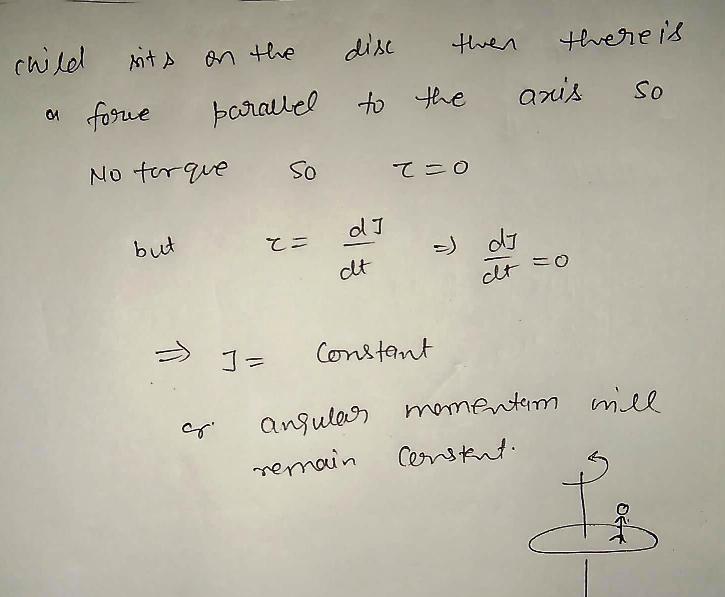
What happen to angular momentum when a child sits on a rotating platform ?
No change in angular momentum(J).
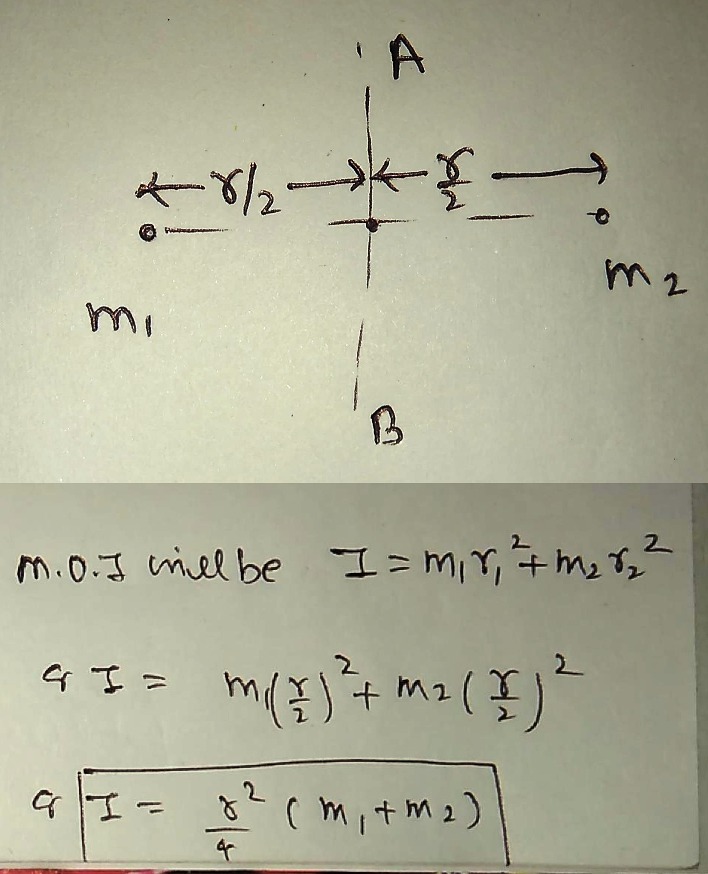
What will be the moment of Inertia (MoI) if the axis of rotation is passing through the mid point between two masses ?
Draw a diagram and solve.
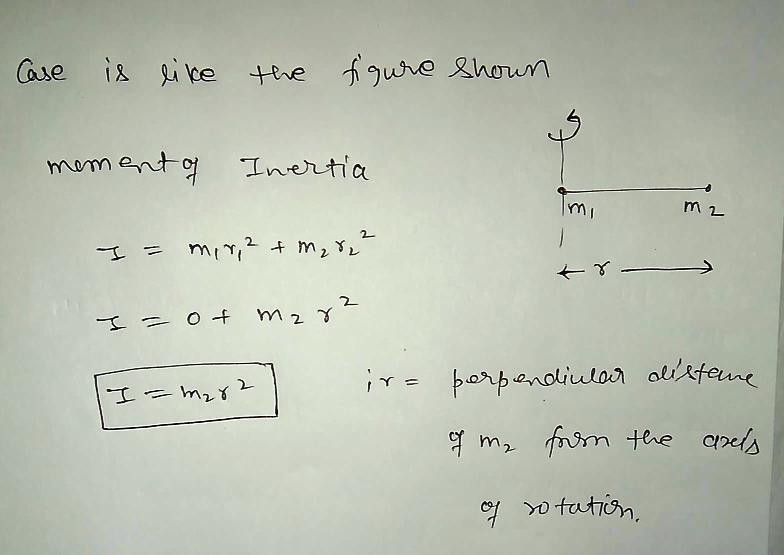
What if the axis of rotation(AoR) is passing through one of the masses ?
Contribution of the mass falling on AoR will be zero.
What if the axis of rotation is passing through the masses ?
Moment of inertia about that axis of rotation (AOR) will be zero.

