Explore for "promotable images/quotes" at your social media for a better society.
Read Now


1. Understand each definition by working out on each word used in it, refer to diagrams and imagine the mechanism discussed.
2. Solve numericals by analysing the examples, more numericals may leads to greater clarity of the concepts.
3. Learn to interconnect two properties like :
Pressure by gas molecules and its dependence over temperature
Pressure is force per unit area normal to force
Force is rate of change of linear momentum
momentum is product of mass and velocity
velocity is related to energy
energy is related to temperature.
Now reverse it
higher temperature means more energetic gas particles
more energetic gas particles means greater velocity
greater velocity means greater momentum
greater momentum means larger change in momentum
leading to greater force which in turn may lead to higher pressure.
Note- If the piston of a cylinder containing gas is free to move then on heating (or increasing the temperature) the gas, pressure remians constant (as piston get shifted due to increased force by the gas molecules) and volume increases due to faster moving particles/molecules while if piston is fixed then volume is fixed so on increasing temperature the pressure will increase.
4. Be good at interpreting formula; viz. learn to deduce dependency of various parameters on each other involved in a formula.
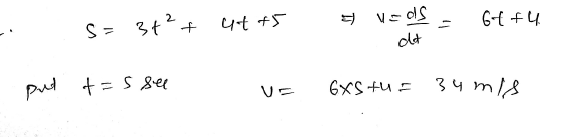
For example, in v = a*t
means v is directly proportional to a if t is constant in words greater acceleration, means greater speed after a particular time t .
in a = Force / mass
acceleration a is inversely proportional to mass m for a fixed force. In other words for a heavier body the same force will generate lower acceleration.
It is quite easy to check facts if formula is known to you.
for example-
Whether resistance for a conductor inreases or decreases with increase in temperature ?
one way - increased rate of collisions between free electrons will increase resistance.
Another way- R2 = R1 (1 + alpha * t )
as alpha is positive for conductors so final resistance R2 will be higher than initial resistance R1 after increasing temperature by t.
Best Wishes.
It has been observed that many students commit a mistake to add 273 in temperature difference while converting the temperature difference for a body in degree centigrade to kelvin. While is to be noted that if temeperature of a body is changed by t degree at centigrade scale then the temperature change at kelvin scale will be just t kelvin not t + 273.
Mathematically
t = t2 - t1 degree centigrade
difference at kelvin scale will be t2 + 273 - (t1 + 273) = t2 - t1
both have same numerical value.
In the chapter for properties of liquid the principle of continuity states that velocity will be greater where cross sectional area of the pipe is smaller and vice-vers, the same can be remembered with analogy of watering pipe, when we pinch its opening a little bit water comes out of it with greater velocity and goes to much larger distance helping us to cover larger area by standing at a single location.
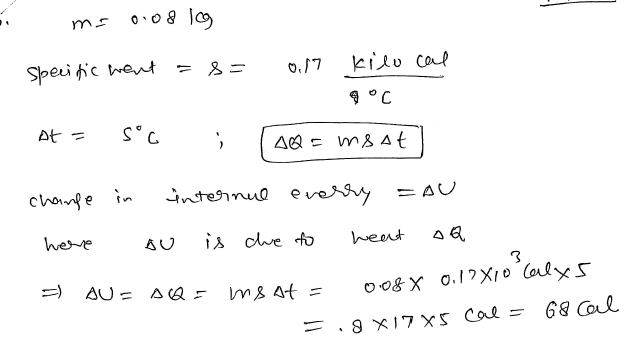
Heat is energy in transition, from higher temperature body to body at lower temperature.
If "no loss of energy" then energy absobed by cooler body = energy exhausted by hotter body
For example if m gram ice cube is droped in M gram hot water then to calculate the final temperature of the mixture following step by step method may be employed:
if value of M and its temperature is sufficient enough to melt the ice
then heat required to melt the ice is mL where L is latent heat of fusion for ice.
heat required to increase the temperature of this m gram 0 degree water is ms(T - 0) where s is the specific heat for water and T is the final temperature of the mixture.
Heat exchausted by M gram hot water during cooling down from T1 to T is MS(T1 - T).
as per calorimetry MS(T1 - T) = mL + msT
Note- First ice will fully melt only then its temperature will start increasing provided energy is availble with hot water in other words it is hot enough.
For minimum wavelenght full KE of the electron will be converted to photon so energy of photon is eV in turn wavelength proportinal to V^-1 that is inversely proportionsal to V.